
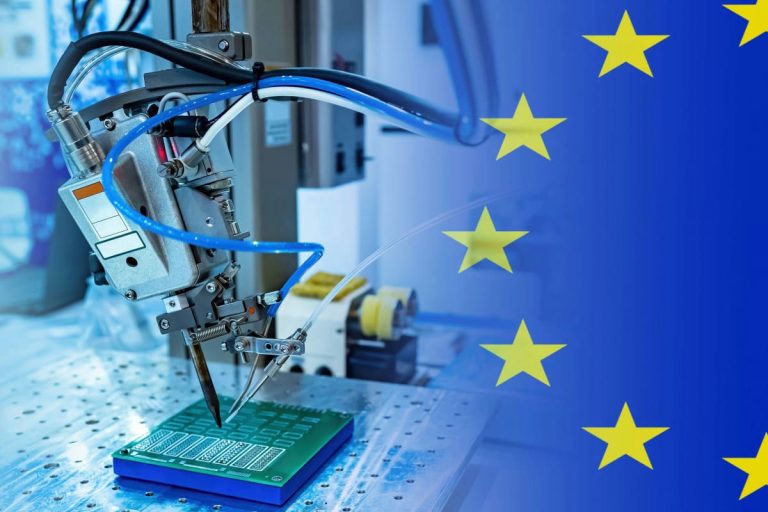
The European Union (EU) has always been at the forefront of technological regulation, and industrial robotics is no exception. The regulatory framework established by the EU aims to ensure a harmonious integration of robots in industrial environments while minimizing risks to workers and promoting innovation. This framework is mainly based on two key documents: the Machinery Directive 2006/42/EC and the Product Safety Regulation (Regulation (EU) 2019/1020). The Machinery Directive 2006/42/EC is a cornerstone, governing the design and manufacture of machinery, including industrial robots, to meet essential safety requirements. It requires manufacturers to ensure that their products comply with strict safety and performance standards before they can be placed on the market. Robots must be designed to protect users against potential risks, such as burns, electric shocks, or mechanical malfunctions. In addition, the Product Safety Regulation establishes market surveillance modalities and the responsibilities of economic operators. It ensures that only products complying with EU requirements can circulate freely in the European territory. This implies not only rigorous quality controls but also corrective measures in case of non-compliance. Furthermore, the EU regulatory framework is enriched by harmonized standards, such as those proposed by the International Electrotechnical Commission (IEC) and the International Organization for Standardization (ISO). These standards provide detailed technical specifications for risk assessment, design, and maintenance of industrial robots. This mix of directives and standards creates a conducive environment for a safe and effective deployment of robotic technologies. Companies must navigate this complex system to remain compliant, which can be a challenge, but also an opportunity to improve their production and safety standards. With a well-defined regulatory framework, the EU ensures that industrial robotics evolves safely, benefiting workers, businesses, and the economy as a whole.
Technological innovation in industrial robotics is progressing at an impressive speed, but it must continually align these advances with strict compliance requirements. Companies developing and using these technologies must remain agile to integrate these innovations while adhering to existing regulations. Among the notable innovations are collaborative robots, or cobots, which are designed to work safely alongside humans. These robots are equipped with advanced and sophisticated sensors, as well as artificial intelligence technologies to avoid collisions and adapt to changing environments. However, their deployment must meet specific compliance criteria, such as those defined by the ISO/TS 15066 standard. This standard stipulates limits on force and power to ensure that cobots can operate safely in the presence of humans. Another crucial aspect of technological innovation is the integration of the Internet of Things (IoT) into industrial robotic systems. IoT solutions enable smooth communication between different machines and platforms, facilitating real-time production and predictive maintenance management. However, this interconnectivity also increases cybersecurity risks, requiring companies to adopt strict measures to protect critical data and infrastructures. Computer vision is another technology transforming industrial robotics. By using advanced image processing algorithms, robots can now perform complex quality recognition tasks with high precision. This is particularly useful in automated product inspection. For these systems to comply with EU directives, they must incorporate redundancy mechanisms and safety systems to prevent failures. Industrial drones and autonomous mobile robots (AMR) are also part of this technological revolution. They are used in warehouses and factories for internal logistics, material transport, and surveillance. The compliance of these machines involves not only safety standards but also regulations on their operation in shared spaces with human workers. Finally, compliance requirements do not stop at the design and manufacturing of robots. They also encompass training workers in the safe use of these technologies and the regular maintenance of machines to prevent performance degradation or safety risks. In conclusion, while technological innovations open exciting horizons for industrial robotics, compliance requirements remain an essential element for their implementation. Companies must maintain a balance between adopting new technologies and adhering to the safety and performance standards defined by the EU.
The European Union’s directives on industrial robotics have a significant impact on businesses, affecting both their daily operations and long-term development strategies. In the short term, the costs of compliance can be high. Companies must invest in advanced technologies, safety audits, and staff training to meet regulatory requirements. However, these investments often pay off in the long term as they promote more efficient production, reduce risks, and strengthen competitiveness in the global market. One of the major impacts of the EU directives is the improvement of workplace safety. Industrial robots, when properly regulated, can perform dangerous or repetitive tasks, thereby reducing the risk of accidents for human workers. This results not only in a safer working environment but also in increased employee satisfaction and productivity. The directives also stimulate innovation within companies. Performance and safety standards require manufacturers to design more reliable and versatile robots. This leads to technological advances that can be applied to other areas, such as smart building automation or medicine. By imposing high standards, the EU encourages companies to push the boundaries of technology and explore new solutions. Moreover, the EU regulatory framework for industrial robotics reinforces the confidence of consumers and business partners. European companies can capitalize on their compliance with EU standards to access new markets and establish international partnerships. This compliance is often perceived as a mark of quality and reliability, which can be a major competitive advantage. In terms of future prospects, the EU regulatory framework will continue to adapt to technological advances and emerging challenges. The European Commission is currently working on initiatives to integrate ethical and environmental considerations into robotics regulation. This could include additional requirements for sustainability and energy consumption, encouraging companies to adopt more environmentally friendly practices. Finally, training and education will be key elements in taking advantage of developments in industrial robotics. Educational programs will need to be updated to include skills in robotics, programming, and cybersecurity. This will help create a skilled and adaptable workforce ready to meet the demands of tomorrow’s job market. In summary, EU directives on industrial robotics have a profound impact on businesses, requiring them to invest in safety and innovation. While this can be challenging in the short term, long-term benefits include improved workplace safety, increased innovation opportunities, and strengthened global competitiveness. As technological developments and regulations continue, European companies are well-positioned to take advantage of future developments in industrial robotics.