
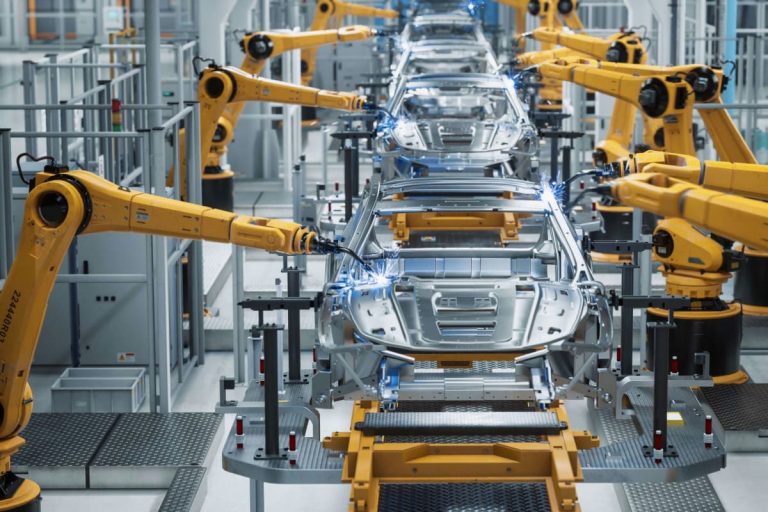
Industrial automation relies on the integration of technology to perform production tasks with limited human intervention. Since the first assembly lines, the goal has always been to maximize efficiency and minimize human errors. Automation combines computer systems, machines, and software to control production processes, often with high levels of precision and repeatability. Industrial robots are a crucial part of this revolution. As early as the 1960s, the first programmable robots were introduced in factories, laying the foundation for modern industry. The first industrial robot, Unimate, was installed in a General Motors plant in 1961. Over the decades, technology has evolved at a remarkable pace. Robots have progressed from simple repetitive tasks to advanced capabilities such as computer vision and artificial intelligence. Today’s robots can not only assemble parts but also inspect quality and adjust in real time to optimize production processes.
Regarding the main robotization technologies, several types of robots are used in the industry: articulated robots, SCARA robots (Selective Compliance Assembly Robot Arm), Cartesian robots, and collaborative robots. Articulated robots, often used in assembly lines, are known for their flexibility and ability to mimic human arm movement. They can perform a variety of tasks from welding to precise assembly. In terms of costs, these robots have a higher initial cost but offer efficiency and longevity that justify this investment. SCARA robots, on the other hand, are primarily used for fast and precise assembly tasks. Their simplified structure makes them less expensive than articulated robots. Cartesian robots are often found in material handling and transport applications. Their three-axis structure (X, Y, Z) allows for linear and repetitive movements with high precision. These types of robots are relatively cheaper and simpler to program. Finally, collaborative robots, or ‘cobots,’ represent a major innovation. Designed to work safely alongside humans, they offer additional flexibility while ensuring operator safety. Cobots have a high initial cost, but their benefits in terms of versatility and safety offset this initial expense.
The adoption of industrial robots involves significant initial costs, including the purchase of the robot, installation, and employee training. However, the long-term savings are undeniable. Robots reduce human errors, increase production, and decrease labor costs. For example, a study by the International Federation of Robotics showed that companies investing in automation see a reduction in production costs of over 50% after five years. In the short term, costs are mainly related to the purchase and installation of machines. But in the long term, savings manifest in reduced working hours, lower energy consumption, and decreased waste materials. For illustration, Ford invested in an automated assembly line that reduced its labor costs by 40% and increased its production efficiency by 20% in just two years. In the electronics industry, a company like Foxconn has implemented robots to assemble components, reducing the need to manually check each circuit. The savings generated by this automation result in lower repair and replacement costs, in addition to accelerated production.
Automation also leads to significant productivity gains. Robots can operate 24/7 without breaks, illness or fatigue, something not possible with human labor. A McKinsey study revealed that the implementation of robots in certain industrial sectors contributes to productivity increases ranging from 30% to 200%. For example, Tesla has automated a significant part of its production lines, which has allowed it to produce vehicles at a considerably accelerated rate. However, one of the most significant impacts of automation is the improvement in quality. Robots precisely follow programmed instructions, reducing errors that may occur with human operators. This results in consistent quality and reduced defective products. For example, in the semiconductor industry, the use of robots allows for high precision in handling fragile elements, ensuring a superior quality final product. This quality improvement also has a domino effect on customer satisfaction. A reliable and high-quality product better meets customer expectations, increasing loyalty and repeat sales. Studies show that quality improvements due to automation can also reduce costs related to returns and after-sales services, representing additional savings for the company.
The introduction of industrial robots inevitably transforms the employment landscape. While some human tasks become obsolete, new opportunities arise, requiring different skills. Workers must adapt and learn to interact with these new technologies. The required skills thus evolve towards knowledge in programming, robotic maintenance and data analysis. Many training and education programs have developed to meet this growing need. For example, some universities and technical institutes now offer specific degrees in industrial automation and robotics, training tomorrow’s engineers for new technological challenges. Regarding employment, the effects can be mixed. While some manual jobs are eliminated, automation creates more skilled positions. According to a PwC study, automation could lead to the elimination of 30% of jobs by 2030. However, the same study indicates that automation could also generate the creation of new jobs in technology, machine maintenance, and automated process management. Examples of successful transitions include workers from Ford, where retraining programs have allowed former factory workers to become robotic technicians and automated system operators. These employees, initially threatened by automation, have found a second, enriched professional life with new skills.